Shoe Lift Inserts: The Complete Guide to Height-Increasing Insoles

shoes

Not everyone wants to commit to a full pair of elevator shoes to feel a little taller. Sometimes you already own great shoes and just want to add a discreet lift. That is exactly what shoe lift inserts, also called height-increasing insoles, are designed for.

They slip into almost any pair of shoes you already own, add anywhere from about 1cm to 5cm of hidden height, and cost a fraction of what a new pair of shoes would. Here is everything you need to know before buying your first pair.

What Are Shoe Lift Inserts?

A shoe lift insert is an insole with a raised heel section (or a full-length lift) that sits inside your existing shoe and boosts your height. Unlike a full elevator shoe, where the lift is built into the shoe itself, an insert is portable. You can move it between pairs, take it out when you do not need it, and try different lift heights depending on the occasion.

There are three main types on the market:

Heel-only lifts raise just the back of the foot. They are the cheapest option and add roughly 1cm to 3cm of height, but they can feel unstable if the lift is too high because your heel sits above the level of the shoe.

Full-length elevator insoles run the entire length of your foot with a graduated lift at the heel. They are more comfortable for longer wear and typically add 2cm to 5cm of height. This is what most people should buy.

Combination or stackable lifts let you add or remove layers to adjust the height. Useful if you want flexibility, but they can be bulky in shoes that fit snugly.
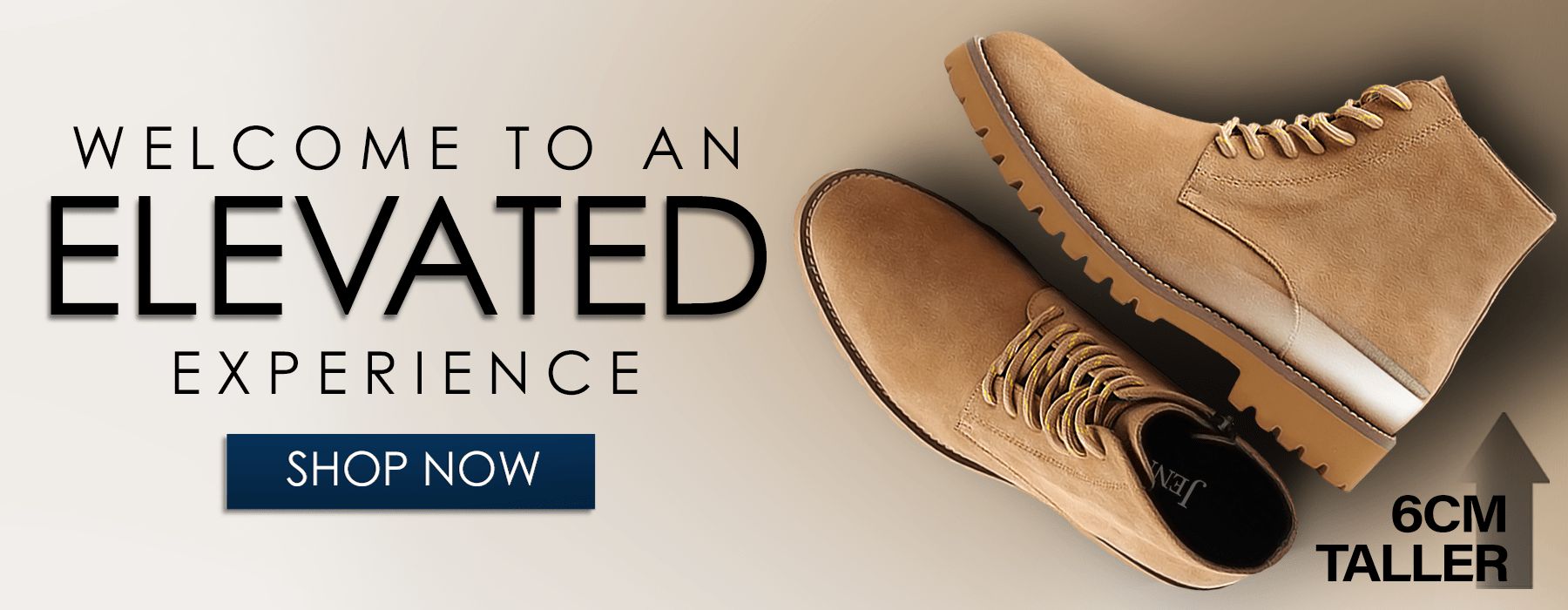
JENNEN Shoes

How Much Height Can You Actually Gain from Insoles?

The honest answer depends on the shoe you are putting them in.

  • Sneakers, boots, and casual shoes usually have room for a 3cm to 5cm insole without any issue.
  • Formal dress shoes typically fit a 1.2cm to 2.5cm insole comfortably. Anything taller often pushes your heel out of the shoe.
  • Slim or tight-fitting shoes may only accommodate a thin 1cm lift.

Our EZYLIFT insoles come in a range of heights so you can match the lift to the shoe. The 1.2cm option fits almost any pair, including formal Oxfords, while the taller versions are designed for boots, sneakers, and shoes with more internal room.

Carpenter

Insoles vs Full Elevator Shoes: Which Should You Choose?

This is the question we get asked most often. Here is a straight comparison.

Choose insoles if you:

  • Already own shoes you love and want to add discreet height to them
  • Want to try height enhancement before committing to a full pair
  • Only need the boost occasionally (weddings, interviews, dates)
  • Want a flexible, portable option you can move between shoes
  • Are on a tighter budget

Choose full elevator shoes if you:

  • Want more than 4cm to 5cm of height
  • Wear the shoes daily and want built-in comfort
  • Want the lift to be completely invisible from every angle
  • Care about the shoe design, fit, and finish being purpose-built for elevation
  • Want the best long-term comfort for all-day wear

Many of our customers end up owning both: a pair of formal elevator shoes for work and weddings, and a set of EZYLIFT insoles they can drop into sneakers or casual shoes on the weekend.

What to Look for in a Quality Insole

Not all height-increasing insoles are made equal. The cheap ones on marketplace sites tend to fail on three fronts: they slip inside the shoe, they compress within weeks, and they cause blisters at the heel. Here is what actually matters.

Material. Look for high-density memory foam or medical-grade silicone. These hold their shape over time and cushion each step. Cheap foam collapses within a month of daily wear.

Anatomical shape. A good insole is contoured to support your arch, not just wedged under your heel. Flat lifts push your foot forward in the shoe and cause discomfort.

Grip. The insole needs to stay put inside the shoe. Look for a textured or tacky underside so it does not slide around when you walk.

Breathability. Perforations or breathable fabric on the top layer stop your foot from overheating, which matters more than most people realise for all-day wear.

Discreet appearance. If you take your shoes off in public (at someone's home, at the gym, in Japanese restaurants), a subtle insole is far less noticeable than a bright yellow gel wedge.

Our EZYLIFT range hits all five criteria, which is why we recommend them over the generic options you will find on marketplace sites.

How to Use Shoe Lift Inserts Correctly

Start with the lowest lift. If you have never worn insoles before, buy a 1.2cm or 2.5cm option first. Your calves and Achilles need a week or two to adjust to any change in heel height. Jumping straight to a 5cm insert on day one is a recipe for sore legs.

Remove the existing insole first. Most shoes come with a thin insole that can be lifted out. Removing it gives you more depth for the height insert and stops the shoe from feeling cramped.

Check the fit before wearing them out. Walk around the house for an hour first. Your heel should not lift out of the shoe, and there should be no pressure points at the top of the foot.

Size up if in doubt. If you are between shoe sizes and want to add insoles, order the larger size. This is why we suggest ordering one Euro size larger with a set of 1.2cm EZYLIFT insoles if you are unsure. Full sizing details are on our size guide.

Rotate between pairs. Do not wear the same insoles in the same shoes every day. Rotating lets both the shoe and the insole recover between wears, which extends their lifespan.

Common Questions About Shoe Lift Inserts

Can people tell you are wearing them?
No, as long as you choose a lift that fits inside the shoe properly. If the insole is too tall for the shoe, your heel will sit above the top line and the shoe may gape at the back. That is when it becomes obvious.

Are insoles as comfortable as regular shoes?
A good quality insole is very comfortable once you have adjusted to the lift. Cheap insoles are not. Spend a little more on a well-made pair and you will barely notice them.

How long do insoles last?
Quality memory foam or silicone insoles typically last 6 to 12 months of daily wear before they start to compress. Cheaper foam versions can flatten in weeks.

Can I wear them for exercise?
Light activity like walking is fine. For running or high-impact sport, we recommend sport-specific insoles rather than height lifts, because the biomechanics change with a raised heel.

Will they hurt my feet or back?
Not if you introduce them gradually and choose a sensible height. Most customers report improved posture, not worse. If you feel calf tightness in the first week, that is normal as your Achilles adjusts.

Can women wear them too?
Yes. Our EZYLIFT range fits both men's and women's shoes with enough internal room.

How do I clean them?
Wipe with a damp cloth and mild soap. Do not soak them or put them in the washing machine, as this breaks down the foam.

Ready to Add Some Height?

Shoe lift inserts are the easiest, cheapest, and most flexible way to add hidden height to shoes you already own. For most people, a 1.2cm to 2.5cm insole is the perfect starting point.

Browse our full EZYLIFT height-increasing insoles collection, or if you decide you want a bigger lift with built-in comfort, explore our best-selling elevator shoes and new arrivals.

Every JENNEN product is designed in Australia and backed by our fit guarantee, with free worldwide shipping on all orders. If you want to try before you buy, visit our Melbourne store to see the range in person.

Small lift, big difference.


Men's Shoe Size Guide

FOOT LENGTH (MM) EURO SIZE AUS / UK SIZE US SIZE
235 37 4 6.5
240 38 4.5 7
245 39 5.5 7.5
250 40 6 8
255 41 7 8.5
260 42 8 9
265 43 9 10
272 44 9.5 10.5
280 45 10 11
288 46 11 12

Measure the length of your feet in mm, with your heels against a wall. 

For increased accuracy, ask for assistance when measuring. 

If you have broad feet, we recommend selecting one euro size larger than your measurement.

It's common for one foot to be slightly longer than the other. For example, if your results are: right foot (254mm) and left foot (257mm), then we recommend size 42.

If unsure about sizing, we recommend ordering one euro size larger and a set of 1.2cm Ezylift Insoles. These shoe lift insoles can be inserted into your JENNEN Shoes if there is a little extra room inside, or into your regular shoes for extra height and cushioning. 

Women's Shoe Size Guide

FOOT LENGTH (MM) EURO SIZE AUS / US SIZE UK SIZE
212 35 4 2
220 36 5 3
229 37 6 4
237 38 7 5
246 39 8 6
254 40 9 7

Measure the length of your feet in mm, with your heels against a wall. 

For increased accuracy, ask for assistance when measuring. 

If you have broad feet, we recommend selecting one euro size larger than your measurement.

It's common for one foot to be slightly longer than the other. For example, if your results are: right foot (229mm) and left foot (231mm), then we recommend size 38.

If unsure about sizing, we recommend ordering one euro size larger and a set of 1.2cm Ezylift Insoles. These shoe lift insoles can be inserted into your JENNEN Shoes if there is a little extra room inside, or into your regular shoes for extra height and cushioning. 

Size Guide


Measure the length of your feet in mm, with your heels against a wall.

For increased accuracy, ask for assistance when measuring.

If you have broad feet, we recommend selecting one euro size larger than your measurement.

If unsure about sizing, we recommend ordering one euro size larger and a set of 1.2cm Ezylift Insoles. These shoe lift insoles can be inserted into your JENNEN Shoes if there is a little extra room inside, or into your regular shoes for extra height and cushioning.